EDS Delegation in Riyadh: Dialogue on Vision 2030 and EU–Gulf Partnership
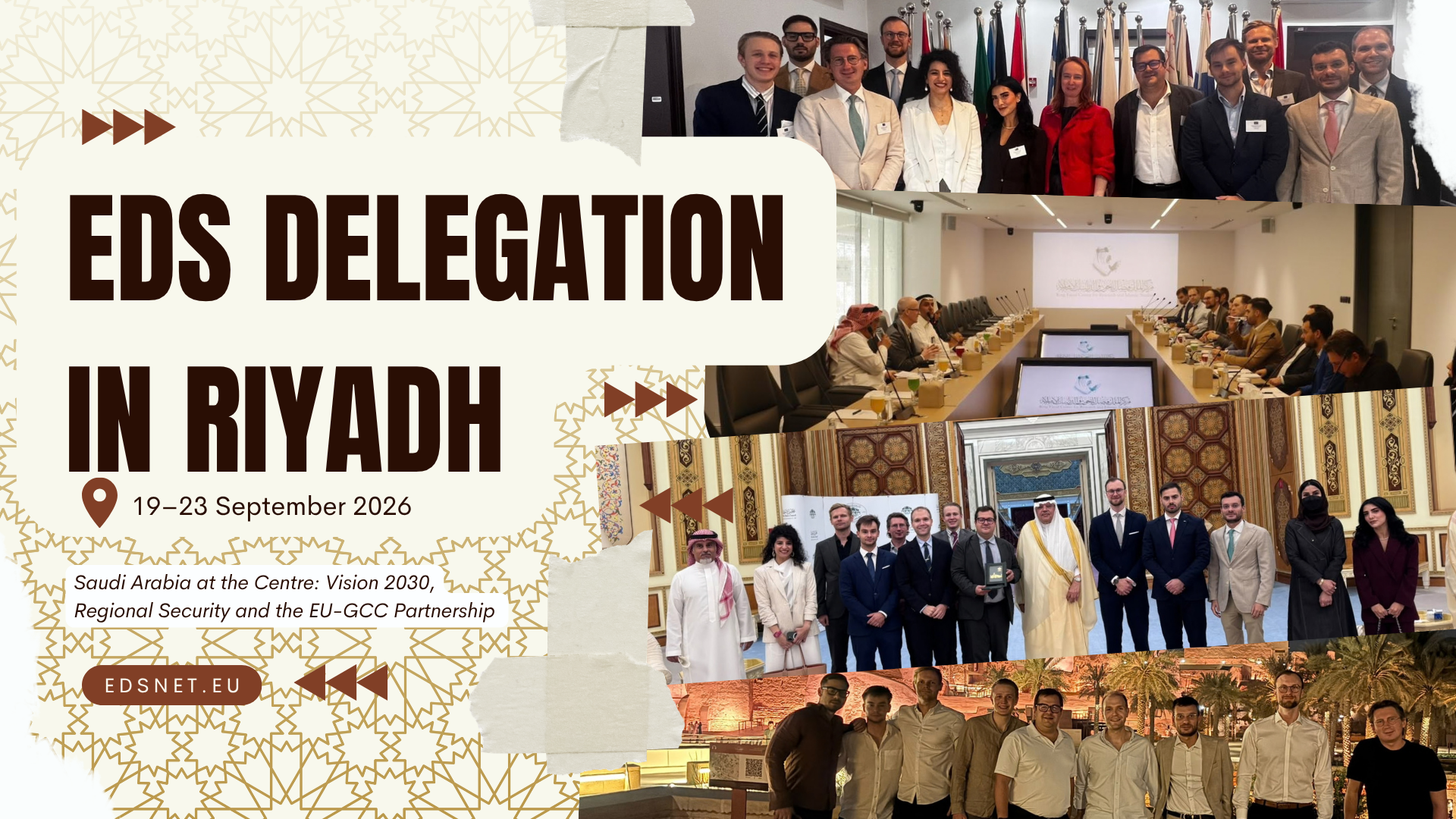
From 19 to 23 September 2026, a delegation of European Democrat Students visited Riyadh for a three-day dialogue programme, "Saudi Arabia at the Centre: Vision 2030, Regional Security and the EU-GCC Partnership", organised by the Konrad-Adenauer-Stiftung's Regional Programme Gulf States. The delegation returned with very positive impressions of a country in rapid transformation.
A Kingdom opening up
Optimism prevailed throughout the meetings. Our Saudi interlocutors described the opening of the Kingdom as a major success, and the figures support this. Over the past decade, Saudi Arabia has lifted the driving ban for women, reformed guardianship and labour laws, and opened its doors to international tourism. The delegation heard that more than 38% of women now participate in the labour force. That is up from 20 percent in late 2018, and the female labour force participation target for 2030 was reached ahead of schedule in 2022. Tourism is booming as well: Saudi Arabia recorded an estimated 122 million visitors in 2025. The Kingdom's ambitions reach further still. Riyadh will host Expo 2030, and the AFC has awarded Saudi Arabia the hosting rights for the AFC Champions League Elite finals for 2026-2027, 2027-2028, and 2028-2029.
At the Shura Council, members of the Foreign Relations, Security and Culture committees explained the Council's consultative role in shaping legislation under Vision 2030. Delegates were especially keen to exchange views with H.R.H. Khalid bin Bandar bin Sultan, Advisor to the Minister of Foreign Affairs. Educated in the United Kingdom and with broad international experience, he offered a candid view of Saudi foreign policy and the Kingdom's strong focus on regional stability. Discussions also covered Saudi Arabia's relations with the United Arab Emirates, its growing ties with China, and its cooperation with Russia within OPEC+.
A difficult regional situation
The programme took place against the backdrop of the ongoing war involving Iran and a very difficult security situation for the Kingdom. We discussed Iran's disruption of the Strait of Hormuz and the threat to the Bab el-Mandeb posed by the Iran-backed Houthis, whose attacks are aimed at Saudi Arabia. Delegates stressed that blocking international waterways violates international law and that the international community must act to defend freedom of navigation.
A highlight was the briefing by Thomas Schneider, German Ambassador to Yemen, who gave an excellent account of the situation. Because of the security situation, Germany's Embassy to Yemen operates from Riyadh. We learned that negotiating with the Houthis is a major challenge, since agreements with them are not upheld. We also identified clear room for deeper European–Saudi cooperation in security and energy security.
Youth, finance and people-to-people ties
At the IMF Regional Office, we discussed possible cooperation on financial literacy for young people, a challenge shared by youth in Europe and Saudi Arabia, and on support for new start-ups. We also stressed the importance of people-to-people diplomacy, including the prospect of visa liberalisation for Saudi citizens travelling to Europe. The Kingdom's young population is a great asset, but it also brings a demographic challenge: millions of young Saudis are entering the labour market, and the country must prepare for an ageing society in the decades ahead.
Honest conversations
With our European partners at the EU Delegation and the German Embassy, we also addressed the issues where Europe and Saudi Arabia still differ, including the death penalty and the legal situation of LGBT+ persons. These topics are also part of an ongoing dialogue with Saudi partners.
Where the Kingdom began
The Kingdom is eager to promote tourism and has a rich history to share. In Diriyah we visited At-Turaif, a UNESCO World Heritage Site since 2010. Its mud-brick Najdi palaces were the seat of the first Saudi state in the 18th century and have been carefully restored as a symbol of national identity. A visit to the Saudi National Museum, just ahead of Saudi National Day on 23 September, completed the historical picture.
EDS warmly thanks the Konrad-Adenauer-Stiftung, and especially Philipp Dienstbier, Director of the Regional Programme Gulf States, together with Layan Ounis and Farrah Abdallat, for an outstanding programme and their hospitality.